
Post
A Guide to Bed Sizes: Finding the Perfect Fit for Your Room
Jun
A Guide to Bed Sizes: Finding the Perfect Fit for Your Room
Choosing the right bed size is one of the most important decisions in furnishing any bedroom. Get it right and the room feels balanced, spacious, and functional. Get it wrong and the bedroom can feel cramped and awkward, or conversely, oddly empty and underscaled. With so many standard and specialty sizes available, from the compact twin to the palatial Alaskan king, navigating the world of bed dimensions can feel overwhelming. This comprehensive guide breaks down every major bed size, helping you identify the perfect fit for your room, your sleep style, and your household.
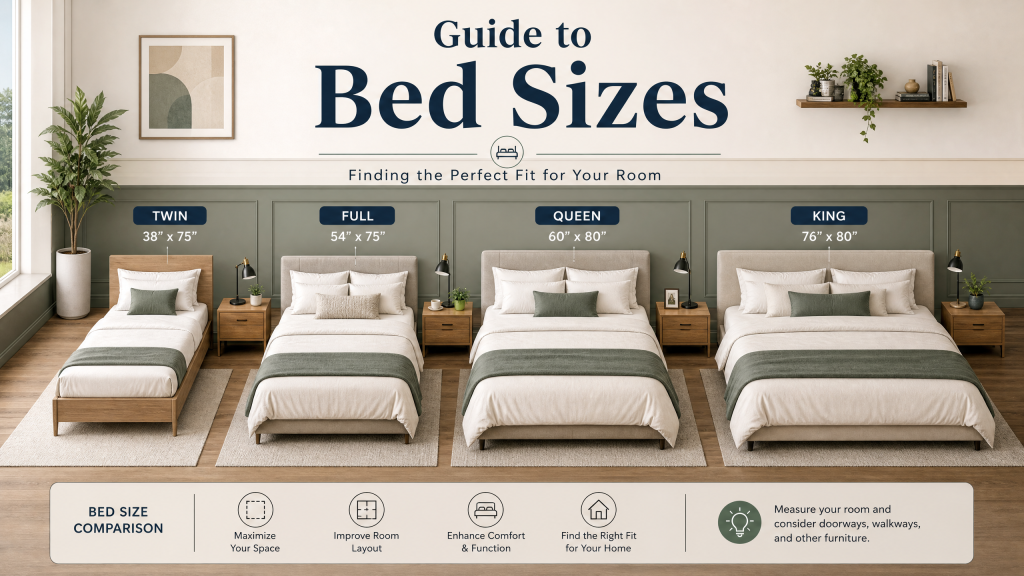
Twin Size (38 x 75 Inches)
The twin bed, also called a single, is the smallest standard adult bed size and one of the most versatile. Its narrow 38-inch width makes it ideal for smaller bedrooms, children’s rooms, dormitory rooms, and guest rooms where space is limited. Twin beds are the most common choice for children transitioning from a crib, as they are appropriately scaled for young children and leave plenty of floor space in the room for play.
Adults who sleep alone in a very small room may also find a twin bed adequate, though most will find it somewhat confining in terms of movement during sleep. Twin beds are also frequently used in vacation homes, hostels, and shared accommodations where maximizing available space is a priority.
Twin XL Size (38 x 80 Inches)
The twin XL shares the same 38-inch width as a standard twin but adds five additional inches in length, bringing the total length to 80 inches. This extra length makes the twin XL the preferred choice for tall individuals who need more legroom, and it is the standard bed size found in most college dormitory rooms across the United States.
Parents of tall teenagers often choose twin XL beds as a forward-looking investment that will continue to serve their child comfortably into early adulthood. Because twin XL mattresses use unique bedding dimensions, shoppers should ensure they purchase appropriately sized sheets and mattress protectors.
Full Size (54 x 75 Inches)
The full bed, also called a double, offers a significant increase in width over the twin, measuring 54 inches across, but shares the same 75-inch length. It provides comfortable sleeping space for a single adult who wants more room to spread out and can technically accommodate two adults, though somewhat snugly.
Full beds are a popular choice for guest rooms because they offer more comfort than a twin for visiting adults while taking up less room than a queen. They are also well-suited for teenagers who want more sleeping space and for studio apartments where every square foot matters.
Queen Size (60 x 80 Inches)
The queen bed is the most popular bed size in the United States and for very good reason. At 60 inches wide and 80 inches long, it offers a comfortable balance between generous sleeping space and a manageable room footprint. Queen beds comfortably accommodate couples while leaving each person approximately 30 inches of sleeping width.
Queens are suitable for master bedrooms as small as 10 by 10 feet, though a room measuring 12 by 12 feet or larger allows for a more comfortable furniture arrangement. Their popularity also means that bedding, bed frames, and accessories are widely available in countless styles and price ranges.
King Size (76 x 80 Inches)
The standard king bed is the widest of the mainstream bed sizes, measuring an impressive 76 inches across and 80 inches in length. This generous width gives couples approximately 38 inches of personal sleeping space each, equivalent to having a twin bed per person.
King beds are an excellent choice for couples who prioritize sleeping comfort, households where pets frequently share the bed, or families with young children who occasionally join their parents. A bedroom measuring at least 13 by 13 feet is generally recommended to ensure the bed does not overwhelm the room.
California King Size (72 x 84 Inches)
The California king, often called the western king, is four inches narrower but four inches longer than a standard king, measuring 72 by 84 inches. This makes it the longest of all standard mattress sizes and an ideal option for individuals over six feet tall.
Despite its slightly reduced width, the California king still provides abundant space for couples. Buyers should remember that California king mattresses require specially sized sheets, mattress protectors, and bedding accessories, which may cost slightly more than standard king alternatives.
Specialty Bed Sizes
Beyond standard mattress dimensions, there are several oversized specialty options designed for those seeking maximum sleeping space. The Texas King measures approximately 80 by 98 inches and is popular among exceptionally tall sleepers. The Wyoming King offers dimensions around 84 by 84 inches, creating a square sleeping surface ideal for families.
The largest commonly available option is the Alaskan King, measuring an enormous 108 by 108 inches. This massive mattress comfortably accommodates multiple sleepers and is often chosen by families who co-sleep with children and pets. Specialty sizes typically require custom bedding and larger-than-average bedroom dimensions.
How to Measure Your Room for the Right Bed Size
Before selecting a bed, carefully measure your bedroom and create a floor plan that includes all furniture pieces. Experts generally recommend leaving at least 24 to 30 inches of clearance on each side of the bed for comfortable movement and daily use.
You should also allow at least 30 inches of clearance at the foot of the bed, particularly if doors, closets, or pathways are nearby. A practical tip is to mark the dimensions of your desired bed size on the floor using painter’s tape. This simple visualization technique can help you understand exactly how the bed will fit within the room before making a purchase.
Factors Beyond Room Size
While room dimensions are important, they should not be the only consideration. Think about your sleeping habits, whether you share your bed with a partner, children, or pets, and how much personal space you prefer while sleeping. Taller sleepers should prioritize mattress length, while couples often benefit from the extra width of queen or king options.
Budget also plays a role, as larger mattresses and bed frames generally cost more and require more expensive bedding. Consider long-term needs as well, especially if you expect your living situation or household size to change in the future.
Conclusion
The right bed size sets the foundation for both a beautifully proportioned bedroom and a restful night’s sleep. By carefully measuring your room, evaluating your sleeping preferences, and understanding the dimensions and benefits of each mattress size, you can confidently choose the option that best suits your lifestyle.
Explore our extensive collection of bed frames and mattresses available in all standard and specialty sizes to find the perfect fit for your bedroom and enjoy years of comfort, style, and quality sleep.
